 Aave
Aave: Borrow amount decisions and health factor checks
Aave lets you compare a proposed borrow amount with the collateral headroom that would remain in your account. Start with the intended debt asset, inspect its borrowing conditions and adjust the amount against the projected health factor. Keeping collateral and account settings unchanged makes that comparison easier to interpret. After confirmation, reconcile the borrowed asset, debt balance and resulting health factor. The available borrowing limit describes capacity under current conditions; it does not prescribe an amount.
Updated -A smaller borrow versus additional collateral
Borrowing less reduces the new obligation, while supplying additional eligible collateral increases the assets supporting it. These choices solve different problems even when both improve projected account health.
The amount field changes how much of the selected token the transaction requests. Adding collateral requires a separate supply action and, where applicable, enabling that supply as collateral. It commits more assets to supporting the position. Leaving the supply unchanged and reducing the request preserves more unused borrowing capacity without increasing that commitment.
Compare amounts before changing several settings together. A simultaneous asset switch or collateral adjustment makes it harder to identify which change caused the preview to improve.
What does the projected health factor tell me?
The projected health factor estimates how well eligible collateral would cover the account's total debt after the proposed transaction, using the prices and parameters available to the calculation.
In V3, health factor equals total collateral value multiplied by the weighted average liquidation threshold, divided by total debt value. Existing borrowing therefore matters alongside the additional amount. The projection does not assess the new loan in isolation.
With collateral values and parameters unchanged, increasing debt lowers that ratio. A value below 1 makes a position eligible for liquidation.
In V3, loan-to-value, or LTV, answers a different question: how much borrowing the collateral configuration permits. The liquidation threshold determines the collateral weighting in the health calculation. V4 uses collateral factors to set borrowing capacity and weight collateral in the health calculation. These parameters do not supply a universal target for every asset combination. Price volatility, the relationship between collateral and debt prices and accumulating interest affect how quickly the displayed margin can change. A preview describes the proposed account state, without fixing future market conditions.
Collateral switches change what backs the debt
The collateral switch determines whether an eligible supplied asset supports borrowing, so a positive supply balance alone does not explain the amount that the account can borrow.
In the V3 interface, the supply section displays each asset's collateral status. Enabling eligible collateral changes the account's borrowing support without requesting another loan. Disabling it removes that support without repaying debt. The protocol rejects a disabling action that would leave the account below its required health threshold.
Read the proposed effect before confirming a switch. Keeping an asset supplied while disabling its collateral use differs from withdrawing it into the wallet. Those actions affect different account records, and a supply balance can remain after its borrowing contribution disappears.
Market selection determines the available controls
The selected network and market determine which balances, borrowing permissions and account parameters the interface evaluates. A wallet's positions elsewhere do not automatically support the displayed request.
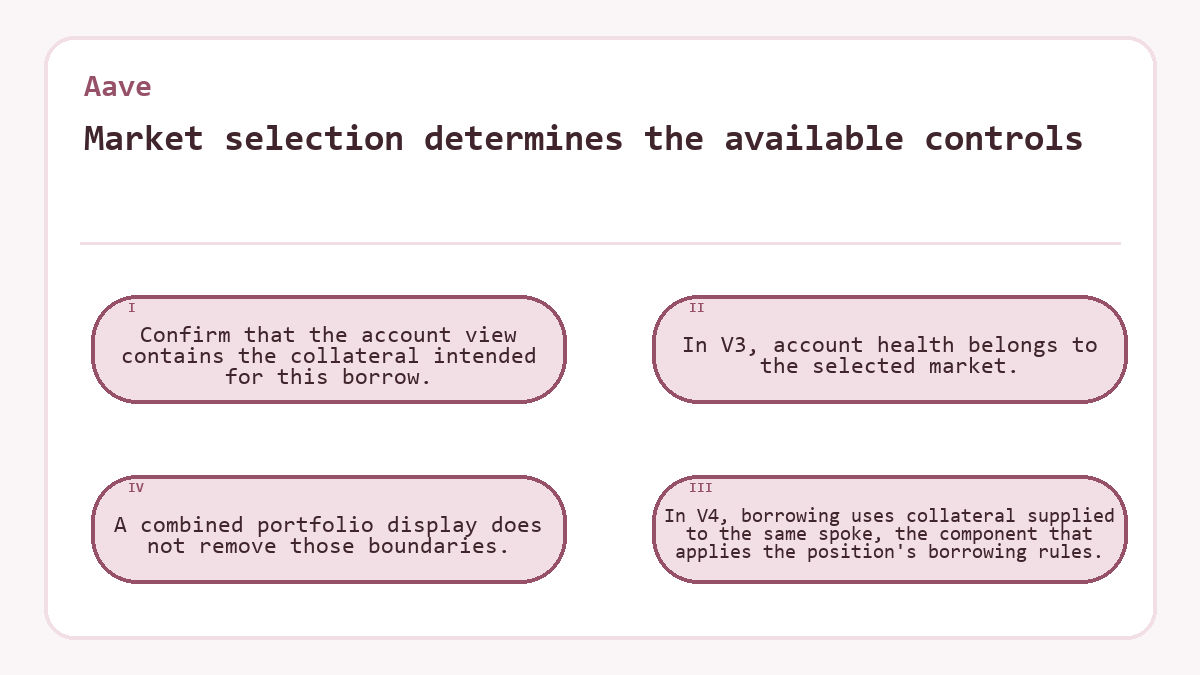
Confirm that the account view contains the collateral intended for this borrow. In V3, account health belongs to the selected market. In V4, borrowing uses collateral supplied to the same spoke, the component that applies the position's borrowing rules. A combined portfolio display does not remove those boundaries.
Asset availability also depends on reserve conditions. Borrow caps, available liquidity and paused or frozen states can restrict a request independently of collateral value. Reducing the amount can address insufficient capacity or liquidity, but it cannot restore permission for an unavailable operation.
E-mode changes eligibility as well as capacity
V3 efficiency mode, or E-mode, applies category-specific collateral parameters and borrowing permissions. Its value depends on whether the selected category supports the intended collateral and debt combination.
An active V3 E-mode category restricts borrowing to assets that the category permits. Compare the listed collateral eligibility, LTV and liquidation threshold before treating the resulting capacity as usable. A higher permitted amount does not make an otherwise incompatible debt asset available.
Changing the category requires a transaction. Existing debt can also prevent a proposed change when the destination configuration does not support it. If the intended combination lacks an eligible category, evaluate the ordinary borrowing configuration only if that configuration permits it. An unavailable category is not a reason to substitute an unrelated asset merely to obtain a larger limit.
The displayed rate describes a changing cost
The borrowing rate affects how the debt grows after execution, while the amount field determines the initial quantity borrowed. Comparing amounts requires attention to both.
V3 variable rates respond to reserve utilization and configured interest-rate parameters. A rate visible during review does not lock the cost for the loan's lifetime. The rate model changes its slope around a configured utilization point, so borrowing costs need not rise evenly as reserve utilization rises.
Where a V4 interface shows an effective borrowing rate, it includes the position's collateral-related risk premium. Compare the projected effective rate rather than interpreting the reserve's base borrowing rate as the full cost. A V4 borrow refreshes the position's collateral parameters and risk premium, even when the collateral assets remain unchanged. Network transaction fees remain separate from the interest that accrues on debt. Neither a low displayed rate nor a high health factor answers both cost and collateral questions.
Wallet requests must match the selected operation
A wallet confirmation authorizes the transaction that it describes, so inspect the selected network, requested action and amount before treating the borrow review as complete.
Approval requirements vary with the operation. Supplying tokens or repaying debt may require permission for a contract to transfer them. Borrowing a network's native asset through the V3 gateway can require credit delegation so the gateway can borrow and deliver the unwrapped asset. That permission has a different purpose from a token spending allowance.
An approval alone does not establish that borrowing succeeded. Keep the authorization request distinct from the transaction that creates debt, and retain access to the network's fee token for subsequent transactions.
Comparing amounts before creating the debt
Consider a borrower who already has eligible collateral in the selected market and wants to retain flexibility for repayment. The intended debt asset and collateral configuration remain unchanged while the requested amount varies.
The smaller request should leave a higher projected health factor than the larger request when other inputs remain equal. Proceed only if the selected amount remains borrowable and its projection fits the borrower's chosen collateral margin. That chosen margin is a personal constraint, not a protocol guarantee.
| Stage | Action or expected change | Required account condition |
|---|---|---|
| Open the relevant account view | Select the network and market holding the intended collateral | Access to the wallet that controls the position |
| Check the debt asset | Inspect borrowing availability and the amount available | Eligible collateral and permission to borrow that asset |
| Compare requested amounts | Change the amount and inspect the projected health factor | The same collateral configuration for a meaningful comparison |
| Review authorization | Complete any permission that the selected borrowing route requires | A compatible wallet and sufficient transaction-fee balance |
| Submit the chosen borrow | Confirm the transaction that creates the debt | Borrowing conditions that still permit the request |
| Reconcile the account | Compare received tokens, recorded debt and resulting health | A successful transaction and refreshed account data |
| Completion | The account records the intended borrow | The resulting health state remains within the chosen margin |
If the asset lacks borrowing permission, lowering the amount does not resolve that incompatibility. Leave the request unsubmitted until an eligible configuration exists. If the preview fails to load, restore a working account view before deciding. Following execution, an unexpected debt amount or health state calls for reconciliation before another borrow; repeating the transaction can create an additional obligation.
Debt records explain more than a wallet balance
The borrowing record identifies the outstanding obligation, while the wallet balance identifies tokens currently available to spend. These figures describe different parts of the transaction.
For a straightforward borrow into the connected wallet, the initial token receipt should correspond to the executed amount. The debt record also reflects the existing obligation and subsequent interest. A later debt balance therefore need not equal the amount typed into the most recent request.
Account data must refer to the same wallet, network and market as the transaction. V3 exposes supplied positions, borrowed positions and market health separately. A stale display or a different market selection can explain an apparent mismatch, but neither establishes that a second submission is necessary. The transaction's execution status and the matching account records provide the relevant evidence.
Repayment flexibility has practical limits
Retaining access to repayment funds makes later debt reduction more practical, although borrowing creates an obligation that a separate transaction must settle.
Aave supports both partial and full repayment of borrowed assets. Repaying with wallet funds reduces debt; supplying additional collateral leaves that debt outstanding. The two actions can improve account health through different sides of the calculation.
Keeping borrowed tokens available preserves access to funds for repayment, but accrued interest can make the total obligation larger than the original receipt. Moving those tokens elsewhere adds dependencies to any later repayment plan. Even after debt reduction, withdrawing collateral remains subject to the account's remaining obligations and the reserve's available liquidity. A smaller initial borrow preserves headroom without guaranteeing immediate access to every supplied asset.
Aave FAQ
Why does the health factor display stay blank before my first borrow?
An account with no active borrowing may have no numerical health factor to display. The ratio requires a debt value, and the documented V3 account-health query returns a null health factor for a supply-only position. A blank current value does not establish whether the proposed borrowing amount is acceptable.
Can I select a fixed borrowing rate in Aave V3?
The documented V3 borrowing method uses variable interest rather than a fixed-rate choice. Its rate follows reserve conditions and configured parameters. An interface that displays a borrowing percentage does not thereby offer a contract that fixes that percentage for the duration of the debt.
Does supply interest automatically cancel the borrowing interest shown in my account?
Supply interest and borrowing interest accrue on separate positions. A net earnings display can combine their economic effects, but it does not mean that supply income automatically repays the debt. The outstanding borrowing balance remains the relevant record when reviewing how much the account owes.
Which debt amount matters when several borrowed assets appear in the account?
The health factor uses the combined value of the account's debt within the relevant market or position. Changing one borrowing amount affects that total. Comparing only the selected asset's balance can miss obligations that already consume collateral support, even when their rows appear separately.
What prevents an isolated collateral position from borrowing the asset I selected?
Where a V3 market uses Isolation Mode, borrowing is restricted to assets that governance permits for that collateral arrangement and subject to a debt ceiling. Extra collateral value does not override those restrictions. The asset must qualify under the active configuration before its requested amount becomes the relevant constraint.
Is an unavailable collateral switch a reason to increase my supply?
An unavailable switch can reflect collateral eligibility or account-configuration restrictions, so increasing the supply may leave the cause unchanged. In V3, an asset subject to zero-LTV restrictions in the active configuration cannot be enabled as collateral. Where the market uses Isolation Mode, its rules can also prevent combining it with another enabled collateral asset.