 Aave
Aave liquidation exchanges collateral for debt repayment when account health falls below 1
Aave liquidation allows a liquidator to repay an eligible borrower's debt and claim collateral with a liquidation bonus. The trigger is a health factor below 1, subject to the market's execution checks. Crossing that threshold exposes the account to liquidation; a successful transaction makes the collateral transfer happen. Repayment or additional eligible collateral can improve account health before execution. Afterward, the remaining collateral, debt and transaction record establish what the borrower still holds and owes.
Updated -Crossing the threshold puts collateral within reach
An account with a health factor above 1 can become eligible when collateral prices fall or its debt value rises. The health factor captures that change using protocol prices and applicable collateral parameters. A value below 1 means the position has crossed the liquidation boundary, even when its unadjusted collateral value still exceeds its debt. Eligibility and execution are separate events. A liquidator must submit a transaction that passes the contract's checks. Once that transaction succeeds, it changes the borrower's balances. A later price recovery does not reverse the transfer.
Can repayment still prevent liquidation below a health factor of 1?
A permitted repayment can remove liquidation eligibility if it restores account health before a liquidator's transaction executes. There is no borrower-controlled reservation while a repayment waits for confirmation. Supplying additional assets helps only when those assets count as collateral for that position, and the supply operation itself must remain available.
A wallet approval only grants spending permission. It does not repay the loan.
Compare the proposed adjustment with the account's latest debt and collateral before committing it. A repayment spends wallet assets to reduce debt; additional collateral commits more assets to the position. Neither action reverses collateral that a liquidator has already taken. The confirmed account state determines whether either adjustment removed eligibility.
The calculation behind the health warning
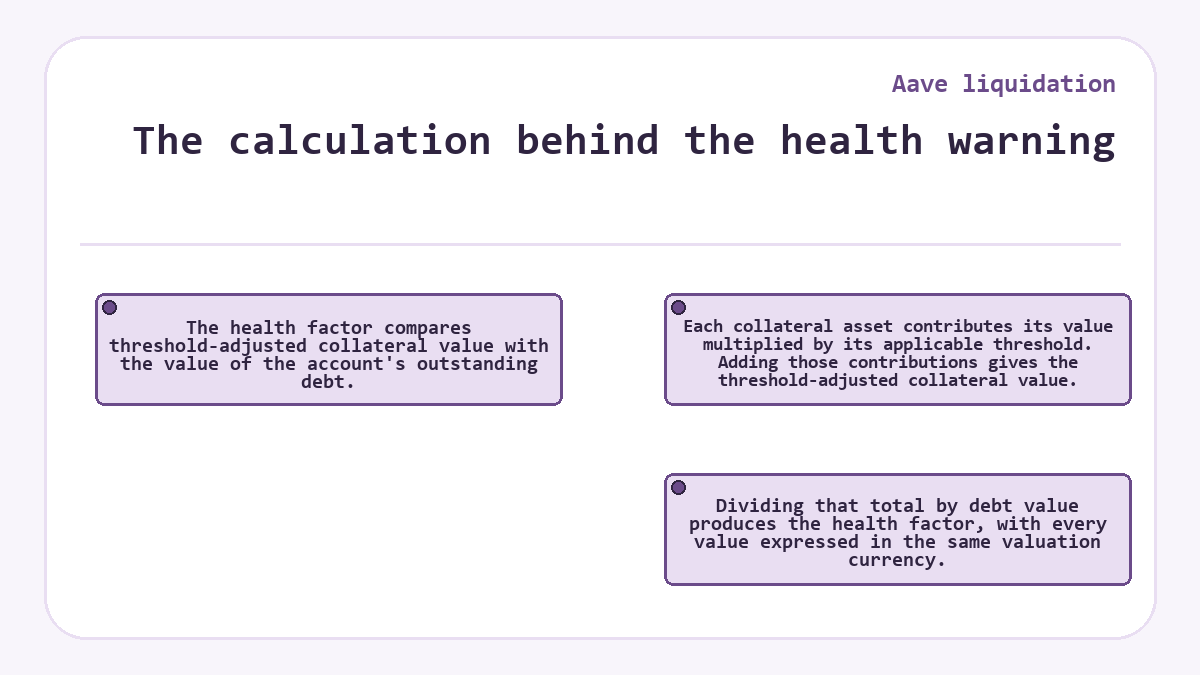
The health factor compares threshold-adjusted collateral value with the value of the account's outstanding debt. Each collateral asset contributes its value multiplied by its applicable threshold. Adding those contributions gives the threshold-adjusted collateral value. Dividing that total by debt value produces the health factor, with every value expressed in the same valuation currency.
For an account with debt, a health factor below 1 means its threshold-adjusted collateral value is smaller than its debt value. Borrowing capacity uses loan-to-value settings, which serve a different purpose from liquidation thresholds. A blocked additional borrow therefore does not, by itself, establish liquidation eligibility.
Liquidation size follows the market version
The amount that a liquidator can repay depends on the deployed liquidation rules, available collateral and the account's condition.
V3 close factors and small balances
A close factor limits how much debt a liquidation can repay. V3.3 changed the default calculation to use total account debt, rather than applying it separately to each borrowed asset.
The ordinary close-factor limit
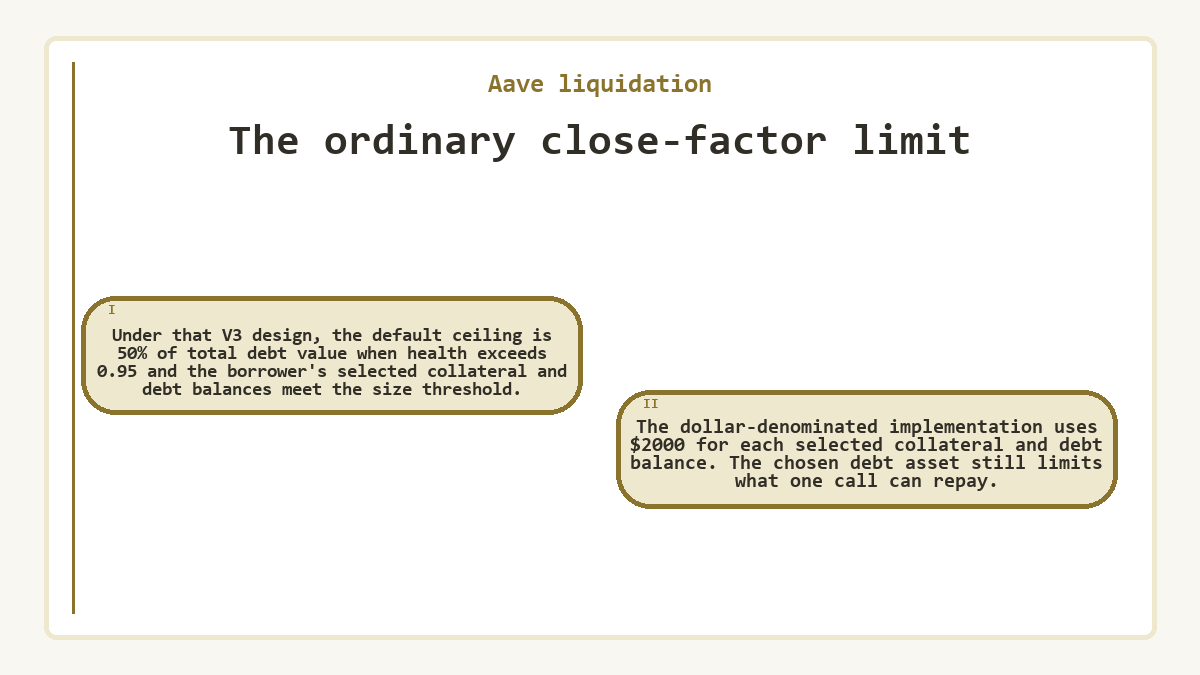
Under that V3 design, the default ceiling is 50% of total debt value when health exceeds 0.95 and the borrower's selected collateral and debt balances meet the size threshold. The dollar-denominated implementation uses $2000 for each selected collateral and debt balance. The chosen debt asset still limits what one call can repay.
Full repayment and dust handling
At health of 0.95 or below, or below either size threshold, the rules allow the selected debt to be fully liquidated. Collateral availability still limits repayment. A partial call that clears neither selected balance must leave at least $1000 of each. These rules prevent small residual balances, commonly called dust.
V4 targets account health
V4 sizes repayment around a configured target health factor for the Spoke, the contract that manages the position. Dust handling can override the ordinary target calculation. Its liquidation bonus also responds to account health within configured limits. A V3 close-factor estimate therefore cannot predict a V4 liquidation amount.
The liquidation bonus increases collateral loss
The borrower gives up collateral worth more than the debt that the liquidator repays because liquidation includes a bonus. The liquidation bonus comes from the borrower's collateral. Its applicable value depends on the market's configuration, including relevant collateral settings. It is not a universal percentage across Aave positions.
Where a protocol liquidation fee applies, it takes a share of the bonus. That allocation explains why the liquidator's receipt may differ from the borrower's total collateral reduction. Keep debt repayment, collateral loss and the liquidator's proceeds separate when assessing the transaction.
A repayment recalculation after collateral loses value
This hypothetical account uses dollar values throughout: threshold-adjusted collateral starts at $4872, debt is $4692 and a proposed repayment is $417. Its starting health factor is approximately 1.038. A price change then reduces adjusted collateral to $4512, with debt unchanged. Health falls to approximately 0.962, crossing the liquidation boundary.
The borrower refreshes the account and checks that repayment remains available, with the required debt tokens and spending permission ready. Before submitting anything, the borrower can revise or abandon the proposed amount. With prices unchanged and no intervening interest or liquidation, repaying $417 leaves $4275 of debt. The calculated health factor becomes $4512 divided by $4275, approximately 1.055.
If repayment executes first, the reduced debt record and refreshed health factor confirm that outcome. A pending transaction leaves the account exposed while the borrower waits for confirmation. If liquidation executes first, the old calculation no longer describes the account. The borrower stops using that preview and reconciles the changed collateral and debt before authorizing another action. Neither branch makes a confirmed transaction reversible.
Oracle prices and transaction ordering affect the outcome
The price that matters for liquidation is the value that the protocol's configured oracle supplies when the contract evaluates the account. An oracle brings price information into the contract's calculations. A chart from another trading venue may show a different value, so its apparent recovery does not establish that the account has moved above the liquidation threshold. Transaction ordering matters too. A repayment preview cannot reserve the state that it displays. Liquidators compete for eligible positions, and network costs, available liquidity and expected proceeds influence whether a transaction is economical. A delay in liquidation is not evidence that the position has become healthy.
The transaction record explains missing collateral
A liquidation record identifies the affected borrower, the debt asset repaid and the collateral involved in the transaction. In V3, the LiquidationCall event also records repayment and collateral amounts. Compare those details with the correct account and market rather than inferring the cause from a wallet balance alone.
Reconcile the remaining debt alongside the supplied collateral balance. In V3, a liquidator can receive aTokens, which represent supplied assets, instead of immediately receiving underlying tokens.
Applicable protocol fee transfers may also form part of the collateral reduction. A single visible token transfer may therefore explain only part of the account change.
Remaining debt determines whether the position can close
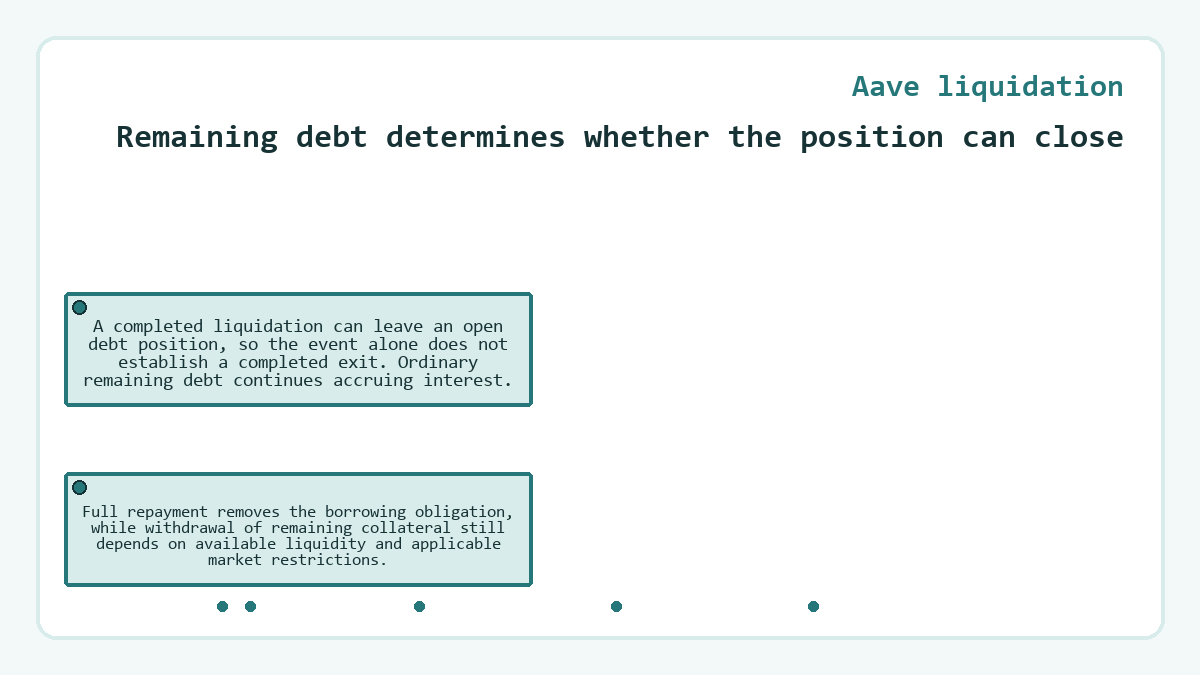
A completed liquidation can leave an open debt position, so the event alone does not establish a completed exit. Ordinary remaining debt continues accruing interest. Full repayment removes the borrowing obligation, while withdrawal of remaining collateral still depends on available liquidity and applicable market restrictions.
V3.3 introduced separate deficit accounting when liquidation exhausts collateral but leaves unpaid debt: the protocol clears the relevant debt tokens and records the shortfall at reserve level. A cleared debt display therefore needs transaction context. For a position that retains debt, the final health check still compares its recalculated health factor with 1.
Common questions about Aave liquidation
Can Aave liquidate supplied assets when the account has no debt?
An account without outstanding debt has no borrowing position for a liquidator to repay. Supplying alone therefore does not create this liquidation exposure. Other risks, including unavailable withdrawal liquidity, can affect supplied assets without a liquidation occurring.
Does efficiency mode prevent liquidation?
Efficiency mode does not remove liquidation eligibility when account health falls below 1. In V3, the applicable category can change collateral thresholds and liquidation bonuses for qualifying assets. Those settings affect the calculation; they do not protect the position from every price divergence.
Why can a displayed health factor of 1.00 be misleading?
A rounded display can conceal a value that lies slightly below the liquidation boundary. The contract evaluates its calculated value at greater precision. A screen showing 1.00 therefore cannot establish which side of the boundary the position occupies.
Which supplied assets can a V3 liquidator claim?
A V3 liquidator must select an asset that the account uses as collateral and a debt asset that it actually owes. The contract checks those conditions along with reserve status and account health. It does not simply choose whichever supplied asset has the largest balance.
Will borrowing interest alone increase liquidation exposure?
Borrowing interest can lower the health factor by increasing outstanding debt even when asset prices stay unchanged. Whether the account crosses the boundary also depends on changes to its collateral balance and applicable parameters. A quiet price chart does not imply a stationary health factor.
Is a frozen V3 reserve the same as a liquidation pause?
Freezing a V3 reserve does not itself disable liquidation. Liquidation validation separately checks active status, pause status and any applicable liquidation grace period. A freeze label therefore does not establish that collateral is temporarily protected from seizure.